perceive / sprout
Negative Space
What's absent defines what's present
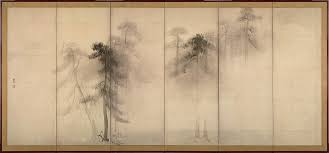
The kanji 間 (ma) combines the characters for “gate” and “moon” — moonlight visible through a doorway’s gap. The Japanese concept names the emptiness between things. Empty space isn’t nothing. It’s what makes the foreground visible.
In Noh theater, Komparu Kunio argues the art form is “no more nor less than the art of ma” — the dynamic balance between movement and stillness, sound and silence. The pause before the mask turns holds more tension than the turn itself.
Tadao Ando’s Church of the Light in Osaka uses a cruciform slit in concrete to let daylight pour into darkness. The room is 113 square meters of shadow. The cross is absence.
!! Anyone adds. Subtraction requires confidence that what remains is enough.
Dieter Rams’s 1956 SK 4 radio for Braun: a white box, speaker grille, two knobs. Hans Gugelot called it “Snow White’s Coffin.” Eighty percent of the surface does nothing. That nothing is the design.
The Braun ET 66 calculator has 24 buttons where competitors had 40. Rams removed functions until what remained was inevitable. Subtraction as craft.
Anyone adds. Subtraction requires confidence that what remains is enough.
Go Deeper
Books
- In Praise of Shadows by Jun’ichirō Tanizaki — Japanese aesthetics of darkness and emptiness.
- Ensō: Zen Circles of Enlightenment by Audrey Yoshiko Seo — On the Zen circle and the presence of absence.
- Dieter Rams: As Little Design as Possible by Sophie Lovell — On Braun’s design philosophy and radical simplicity.
Art
- Hasegawa Tōhaku’s Pine Trees Screen (16th century) — The mist between the pines is the subject.
- John Cage’s 4’33” — Music made of silence.