steward / sprout
Maintenance
The invisible work that keeps things running
David Edgerton’s The Shock of the Old shifts attention from invention to technologies in use: the tools, machines, and systems people keep, adapt, and repair.1 A history told through use looks different from a history told through patent dates.
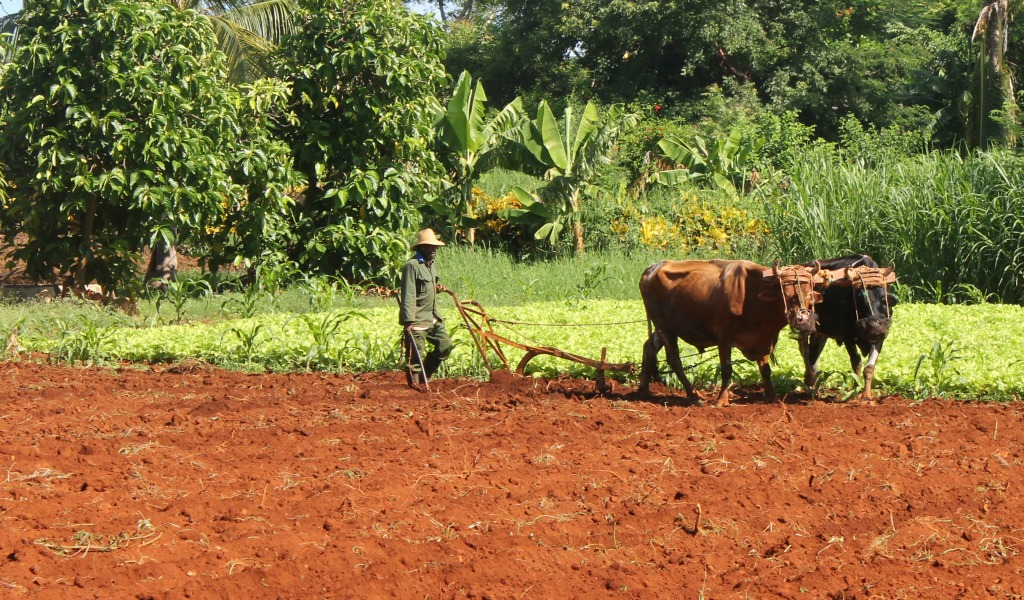
Cuba shows why an older tool can return. Trade with the Soviet bloc began to break down after 1989, and Cuba faced sharp losses of fuel, fertilizer, machinery, and spare parts.2 The Soviet Union dissolved in December 1991.3
Cuba had about 500,000 working oxen in 1960, 163,000 in 1990, and 400,000 by 1997.2 These were oxen, not horses. They did not replace a known count of tractors one for one. Animal traction filled a gap where fuel, parts, soil, farm size, and available labor made it useful.
Germany’s military offers another correction to the usual image of modern war. Sources count the horses used or prepared for the 1941 invasion of the Soviet Union differently: one account gives about 625,000 in the invasion force, while the German Federal Archives says 750,000 had been prepared by June.4 The exact boundary matters less than the scale. Motor vehicles and horses worked beside each other.
Edgerton argues that the horse contributed more to Nazi conquest than the V-2 did.1 That is his historical comparison, not a measured ratio.
He uses “creole technologies” for tools that acquire distinct local forms and uses after transfer.5 Old age alone does not make a technology creole.
New work is easy to point at. Maintenance often removes an event: the bridge does not close, the server does not lose data, the roof does not leak. The result can hide the labor that produced it.
This creates a planning error. A buyer compares purchase prices while leaving out inspection, cleaning, parts, training, downtime, and eventual disposal. A team funds a feature without funding the code that will carry it. A city opens a building without setting aside the staff and money to keep it safe.
Ask four questions before adding a system:
- Who will inspect and repair it?
- Which parts, skills, and records will they need?
- What happens when the supplier, fuel, or budget disappears?
- Can the system fail in small, visible ways before it fails at once?
Maintenance is part of design. A thing that cannot be inspected, repaired, or adapted carries a hidden end date.
Go Deeper
Books
- The Shock of the Old by David Edgerton — Historian’s corrective to innovation-obsessed technology history. Most of the world runs on maintenance.
- Maintenance: Of Everything by Stewart Brand — From the creator of the Whole Earth Catalog. On keeping things going.
- How Buildings Learn by Stewart Brand — How buildings adapt over time. The “Maintenance” chapter is key.
Essays
- “Hail the Maintainers” by Andrew Russell & Lee Vinsel — The essay that launched the Maintainers movement. Argues for valuing maintenance over innovation.
Sources
-
David Edgerton, The Shock of the Old: Technology and Global History Since 1900 (Profile Books, 2006). ↩ ↩2
-
Figures from A. Ríos and L. Aguerrebere (1998), reproduced in “The conversion to organic agriculture in Cuba”. ↩ ↩2
-
U.S. Department of State, “The Collapse of the Soviet Union”. ↩
-
Geoffrey P. Megargee, “Rejecting Catastrophe”, 2019 International Forum on War History, 77–88; German Federal Archives, “Pferde im Einsatz bei Wehrmacht und Waffen-SS”. ↩
-
David Edgerton, “Creole Technologies and Global Histories: Rethinking How Things Travel in Space and Time”, HoST—Journal of History of Science and Technology 1 (2007), 75–112, definition at 101. ↩